
What Crochet Actually Does for Your Brain and Body
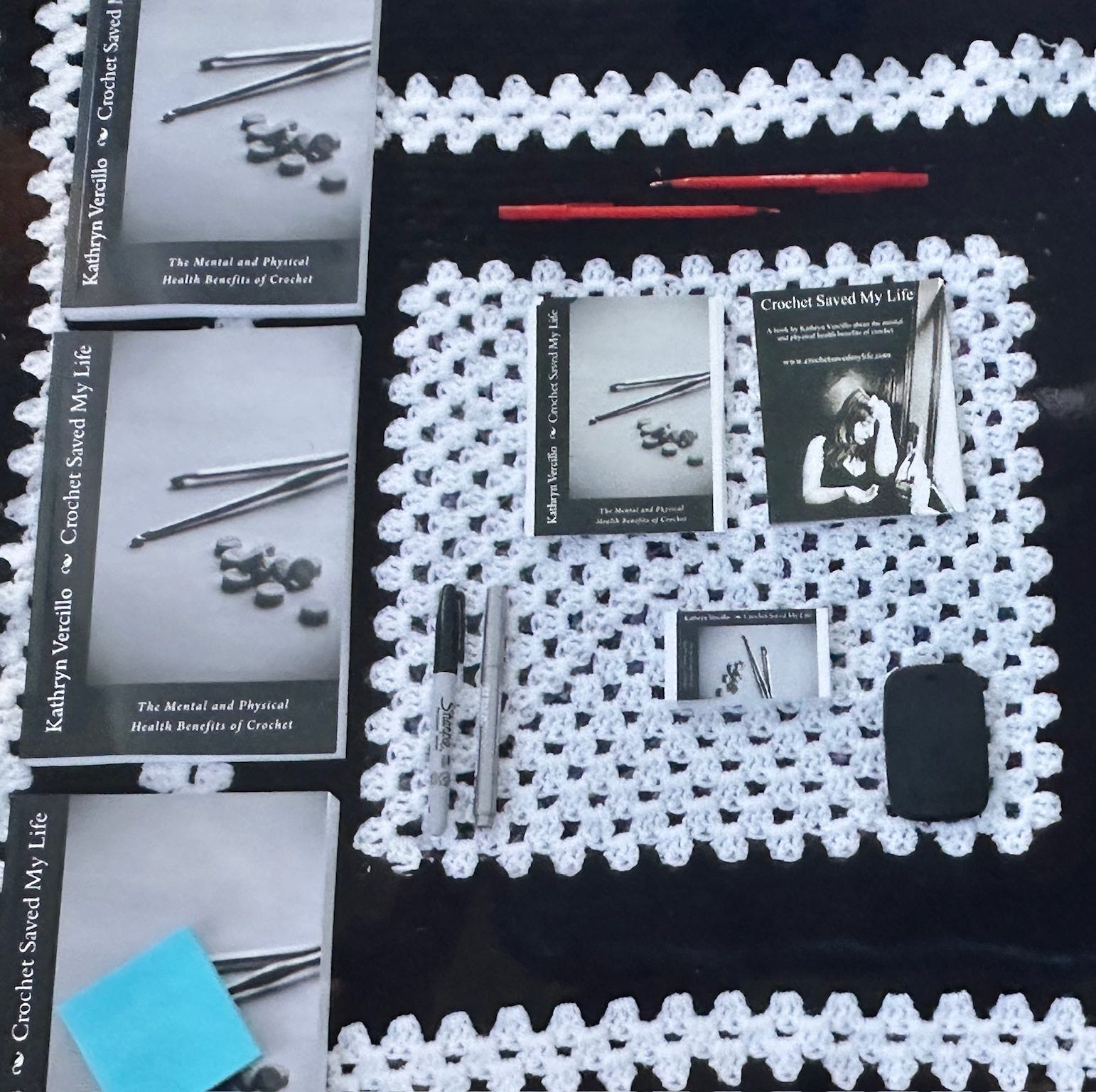
It's been more than fifteen years since my book Crochet Saved My Life came out ... here are the questions people ask me most.

I started researching crochet as therapy around 2010, at a time when there wasn’t a lot of research about it. As a result, people often find me when they begin researching it. That’s included students researching craft and cognition for school projects and authors writing about the mental health benefits of making. Over all of these years of writing about crochet and health, the questions have become familiar, and I find I genuinely enjoy answering them.
Recently I worked through a set of questions from someone researching the cognitive benefits of crochet, particularly for older adults. Going back through both Crochet Saved My Life (2012) and Hook to Heal (2015) to answer carefully reminded me how much ground those books cover. I thought some of you might find the answers useful, so here they are…
Crochet and Mental Health
How can crochet help with depression, anxiety, and other mental health conditions?
When I wrote Crochet Saved My Life, I was documenting not just my own experience but the experiences of nearly two dozen women I had interviewed who had used crochet to navigate depression, anxiety, OCD, PTSD, schizophrenia, chronic illness, and grief. What emerged from those conversations was a picture of crochet as a practice that works on several levels simultaneously:
It helps regulate mood through the release of serotonin, dopamine, and endorphins that creative activity supports. Researcher Kelly Lambert, whose work I referenced in the book, identified what she called an “effort-driven reward circuit” in the brain: a network of regions encompassing reward, emotion, movement, and higher reasoning that activates specifically when we work with our hands to produce something. In modern life, this circuit rarely gets called on. Crochet calls on it.
It also combats the rumination that feeds depression and anxiety by giving the mind a focused task to engage with instead. And it builds self-esteem through the completion of projects, which matters more than it sounds: finishing something, even something small, creates a concrete sense of accomplishment that people struggling with their mental health often have very little access to.
Does it actually help with serious conditions, or just mild stress?
The people I interviewed for Crochet Saved My Life were not managing mild stress. They were living with schizophrenia, PTSD, serious depression, OCD, and chronic illness. One woman used crochet as a touchstone to help ground her in reality while experiencing hallucinations. Another crocheted for charity as a way to move through the grief of losing a child. Hook to Heal has been used by therapists, social workers, and peer counselors in substance rehabilitation programs and prisons.
That said, I am careful to say that crochet is one tool among many, not a replacement for professional care. The research is real and the experiences are real. Crochet is not a cure. What it can be is something reliable to reach for, something that does something useful in the body and mind, even when other things feel out of reach.
Crochet and Cognitive Health
What does crochet do for memory and concentration?
More than most people expect. In Crochet Saved My Life I drew on the work of Stitchlinks, a group that conducted extensive research into needlearts and health, and on Betsan Corkhill’s 2008 research on mindfulness and craft. The counting and sequencing involved in crochet directly engage working memory. As you work a pattern, you hold a stitch repeat in your head, track where you are in a row, and adjust based on what you see developing in front of you. Over time, this becomes automatic, but getting there stretches and maintains the working memory in ways that matter.
I also documented how the craft builds three distinct forms of attention:
selective attention (filtering out distractions)
sustained attention (staying with a task over time)
and divided attention (tracking pattern and progress simultaneously).
These are not small things. They are the foundations of how we learn and function.
What about cognitive skill development more broadly?
Crochet Saved My Life has a full section on cognitive skill development, which was one of the areas that surprised me most in my research. The skills that crochet supports include working memory, problem-solving, attention, planning and strategizing, and visual processing. These are the foundations of how we learn anything.
The research I referenced also describes crochet as a “cognitive filter”: a way of maintaining positive mood by redirecting attention away from negative thought loops, or presenting them in a less threatening way. There is also a theory I found fascinating, put forward by Corkhill, that the back-and-forth motion of needlework may have something in common mechanically with EMDR (Eye Movement Desensitisation and Reprocessing), a therapy that uses bilateral stimulation. It is a theory, not a proven mechanism. But it points toward why the repetitive motion of crochet seems to do something particular to the nervous system that goes beyond simple distraction.
Can crochet help prevent or slow cognitive decline?
This is one of the areas where the research is most striking. The argument, supported by the research I examined, runs roughly like this: the factors that contribute most to cognitive decline in older adults include loneliness, lack of purposeful activity, feelings of uselessness, chronic stress, and high cortisol levels around the brain. A regular crochet practice, particularly a social one, addresses several of these simultaneously.
I wrote specifically about the relationship between crochet and Alzheimer’s prevention. Someone who joins a crochet circle and makes items for charity is combating loneliness, purposelessness, and inactivity at the same time. Crochet as a meditative stress-reduction tool also matters here: chronically elevated cortisol has been associated with memory problems, and if crochet can reliably bring stress levels down, that has implications beyond mood.
There is also a practical physical advantage specific to crochet that I found interesting: because crochet uses one hook rather than two needles, it requires less hand-to-hand coordination than knitting, which may make it more accessible to people with reduced motor control. That lower barrier means more people can access the cognitive engagement it provides, for longer.
Crochet, Emotional Regulation and Mindfulness
How does crochet support emotional regulation specifically?
The mechanism is both physiological and cognitive. The rhythmic physical motion engages the body in a way that can interrupt the anxiety cycle at a physical level. The focused attention required simultaneously crowds out the rumination that sustains distress at a cognitive level. Both things are happening at once.
In Hook to Heal, I included mindfulness as one of the core foundations of the entire program. Mindfulness, as Corkhill defines it, is the state of being aware of yourself, your surroundings, and your relationship to those surroundings in the present moment, aware of pleasant and unpleasant sensations, not worrying about the past or fretting about the future. The rhythmic, repetitive nature of crochet is one of the most accessible routes into that state that I know of. You do not have to try to be mindful. The stitch creates the conditions for it.
The documented benefits of sustained mindfulness practice include enhanced working memory, cognitive flexibility, stress relief, reduced anxiety, and generally improved quality of life. Crochet is not the only path to those benefits, but it is a particularly low-barrier one.
What about focus and problem-solving? How does that work in practice?
For focus, the key is that crochet provides an immersive task: complex enough to hold attention, achievable enough not to overwhelm it. That balance is harder to find than it sounds and is part of why crochet works when other activities do not.
For problem-solving, every pattern requires a crocheter to figure out where they went wrong, how to adjust tension, how to interpret instructions, how to troubleshoot a seam that is not lying flat. These are low-stakes problems with findable solutions. Practicing that loop of noticing, diagnosing, and adjusting has value that extends well beyond the project.
Crochet and Physical Health
Are there physical benefits to crochet, not just mental ones?
Yes. Crochet has been used as an occupational therapy tool for developing fine motor skills. Specifically, it supports finger flexion and extension, range of motion in the hands and lower arms, grip strength, hand-eye coordination, and even oculomotor control, the muscles around the eyes. Many older crafters report that keeping those hand movements active helps maintain hand mobility and staves off the stiffness associated with arthritis.
What should people watch out for physically?
This is underacknowledged, and I think it is important to name. Poor posture is common among crafters who hunch over their work, and the neck and shoulder tension that results can undermine the very relaxation the practice is meant to provide. I continue to have this problem despite years of trying to do better.
Extended sessions without breaks can cause strain in the hands and wrists.
I want to add something here that comes from years of working at the intersection of art and health more broadly: crochet, like any creative practice, does not always help and can sometimes cause harm. I have met people with compulsive tendencies who will continue crocheting long past the point where their body is telling them to stop, resulting in real pain and in some cases long-term damage. Paying attention to what your body is actually communicating during the practice is part of using it well.
The short practical version: take breaks, choose a comfortable ergonomic hook, work in good light, and treat physical discomfort as information rather than something to push through.
Crochet and Older Adults
Why does crochet seem particularly well-suited to older adults needs?
In Crochet Saved My Life, some of the most consistent themes I found around older adult crafters were about purpose and contribution. Many elderly women I spoke with or read about described crochet as the way they continued to contribute to family and community at a stage of life when society had largely stopped asking anything of them. Making something for a grandchild, a charity, or a cause restores a sense of usefulness that matters deeply for self-esteem and overall wellbeing.
There is also the social dimension. Crochet groups and crafting communities provide cognitive stimulation, emotional connection, and a structured reason to engage with others, all of which are among the strongest predictors of healthy aging. Loneliness, boredom, and apathy are themselves health risks, and a regular crochet practice, especially a social one, addresses all three.
How should older adults approach the practice to get the most benefit?
The cognitive benefits come from choosing projects that require genuine engagement: patterns with a stitch repeat to memorize, projects that introduce a new technique, anything that keeps the brain working without tipping into frustration. Too simple and the benefit diminishes. Too complex and it stops being enjoyable.
The physical benefits come from regular, moderate sessions rather than infrequent long ones, with attention to posture and hand comfort. And if crochet with others is available, prioritize it. The conversation that happens alongside crochet is part of what makes it valuable. The hands are occupied, which frees something else in us to be present.
Start with something simple and let the complexity build naturally. Notice how you feel before and after a session, not just what you made. And treat the practice as a gift you are giving yourself, not a task you are completing.
Why crochet specifically?
Wouldn’t any repetitive activity give the same benefits?
This is a question worth taking seriously rather than dismissing, and the honest answer is: yes, kind of, but not exactly. Many repetitive activities have overlapping benefits. Walking, gardening, and other rhythmic physical tasks engage some of the same mechanisms. But crochet has a particular combination of features that I have not found bundled together in many other activities.
In Crochet Saved My Life I wrote about what makes crochet distinct from other crafts, including knitting. Crochet mistakes are easy to undo. You frog the work back and start again, which makes the practice unusually forgiving and unusually well-suited to mindfulness: when frustration arises, it is easy to correct course rather than abandon the project entirely. Other crafts that are harder to undo can tip into anxiety for someone who is already struggling.
Crochet is also genuinely portable in a way that many other therapeutic activities are not. A hook and a ball of yarn fit in a coat pocket. You can crochet on public transit, in a waiting room, during a difficult conversation. That portability means it is available precisely in the moments when you most need something to do with your hands.
And then there is the output. At the end of a session there is a tangible object that did not exist before. That specific feedback loop between effort and result, what researcher Kelly Lambert called the “effort-driven reward circuit,” is something that scrolling a phone or taking a walk does not replicate. The object is evidence that something was made. For many people I interviewed, that evidence mattered in ways that are hard to overstate.
That said, this varies a lot from person to person. I know people who hate crochet and love knitting and seem to get the same benefits. When I wrote these books, I was very focused on crochet-as-therapy and now I’ve expanded my work considerably to look at the broad interaction between art/craft and health/circumstance. The answer is not a simple one.
I, however, still personally love crochet the most.


Like this work?
Oh, Kathryn I thoroughly enjoyed reading this. I always knew I enjoyed crochet but this takes it to another level as to how it helps. Thank you for sharing this amazingly thoughtful piece.
Also, I was delighted to read about how it builds three forms of attention - this is where it resonates with my own creative practice of attention (Moodling and Alchemy of Listening) and links back to my acadmic study on attention. I would so love to go deeper into this - is this something I'd find more of in your book?