
When Thread Becomes Language: On Nicole Nehrig's With Her Own Hands
Two women, two crafts, one blue skein, and what it means to make things in order to survive

I was drawn into this book from its very first page. Take a look at the photo below.
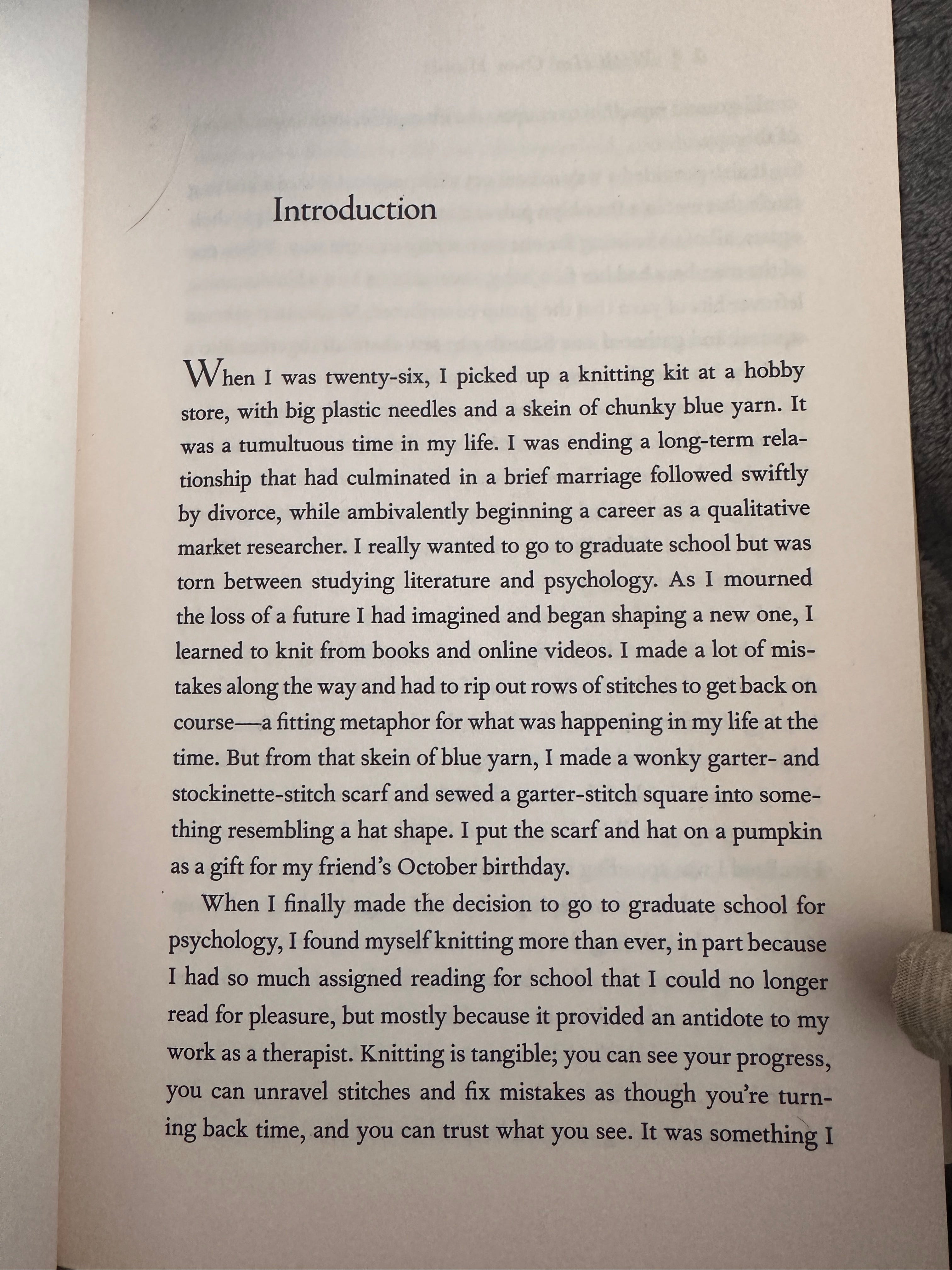
That is the very first page of Nicole Nehrig’s With Her Own Hands: Women Weaving Their Stories. Nehrig describes picking up knitting in her late twenties during a tumultuous period of her life. She taught herself from books and online videos, made a lot of mistakes, ripped out rows of stitches to get back on course. She describes it as a fitting metaphor for what was happening in her life at the time. And then, when she finally made the decision to go to graduate school for psychology, she found herself knitting more than ever, mostly because it provided an antidote to her work as a therapist. It was tangible. She could see her progress. She could trust what she saw.
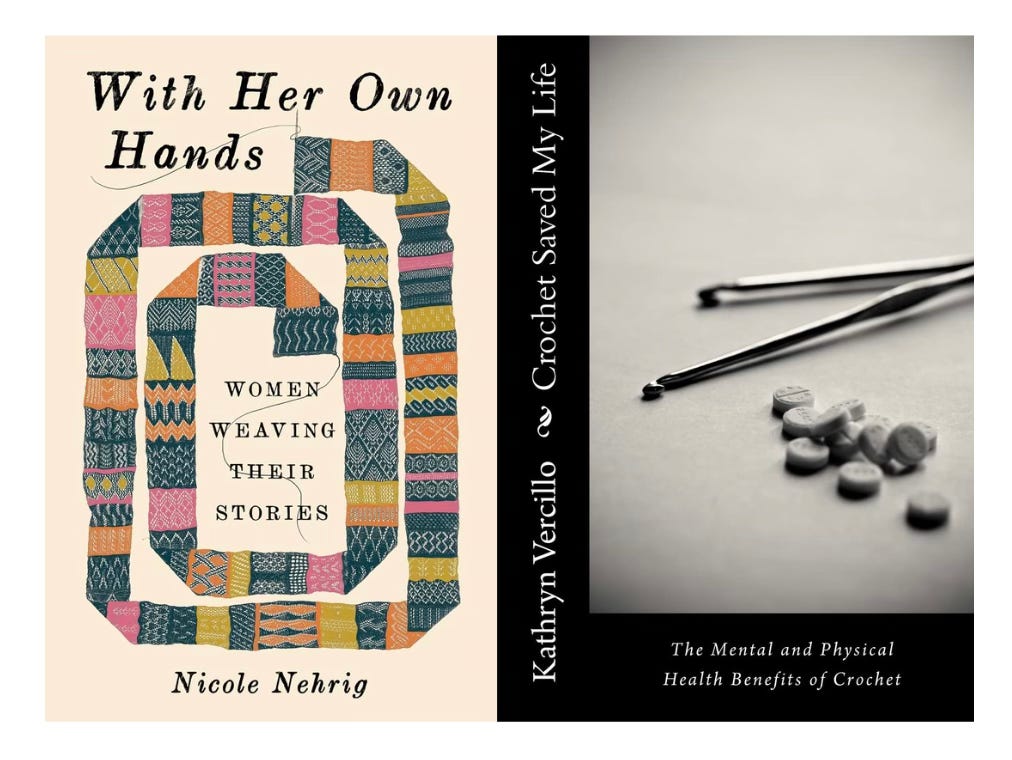
Now, take a look at what I wrote in my own 2012 book, Crochet Saved My Life, about that same period of life:
“That crochet hook became my lifeline. It was my go-to weapon whenever I felt like I needed to pick up another knife or a bottle of vodka or even a pen to write my goodbye letters. I picked up the crochet hook instead. I got books that teach kids how to crochet and I used YouTube videos to learn a few basic stitches.”
I was also in my late twenties. I also taught myself from books and videos. I also found that working with my hands did something for me that nothing else quite could. And years later, when I went on to study psychology at the California Institute of Integral Studies, I sat in those classes crocheting square after square, my hands moving through the repetition while my mind worked through the material. It was the same instinct Nehrig describes: the craft as an antidote, as a counterweight, as the thing that kept you grounded while you were learning to think about the mind.
Two women. Two fiber crafts. Two late-twenties discoveries. Two paths that led toward understanding why making things matters so much to so many of us. That this is also the book Nehrig eventually wrote does not surprise me at all.
I also can’t help but notice her reference to that first skein of blue yarn and remember from my own book/experience, finding crochet in the midst of debilitating depression:
"I went to the craft store with my mom to buy yarn. I immediately drifted over to a soft type of yarn that was wonderful to the touch. I chose blue and grey (a color theme I still love although I suppose it reflected my mental state more than anything at the time). Later I would learn that there are many different types of yarn and thicknesses of yarn and that these things should be taken into consideration when figuring out what yarn you want for a project but I didn't know that at the time so I just bought what I liked. And the fact that I could fairly easily decide what I liked was a really big deal for me at that time. I'll probably never know why choosing blue yarn felt easy when choosing between Ramen noodles and macaroni felt hard but it did."
Thread as Protest, Thread as Preservation
With Her Own Hands: Women Weaving Their Stories is a national bestseller that spans continents and centuries to examine how women have made meaning through textile work, not just personally, but historically, politically, and collectively.
Nehrig’s premise is both simple and quietly radical: textile work, so often dismissed as “women’s work” and attached to ideas of domesticity and obedience, has in fact been one of the primary ways women have exercised power throughout history. When other avenues were closed, women picked up a needle and thread. They used what they had.
The book unfolds across seven chapters, each exploring a different dimension of what textile work has meant for women: intellectual expression, economic independence, community, trauma processing, political protest. Nehrig draws on her training as a psychologist and researcher, and weaves in her own personal relationship with making. The result moves fluidly between the scholarly and the intimate, between historical analysis and lived experience.
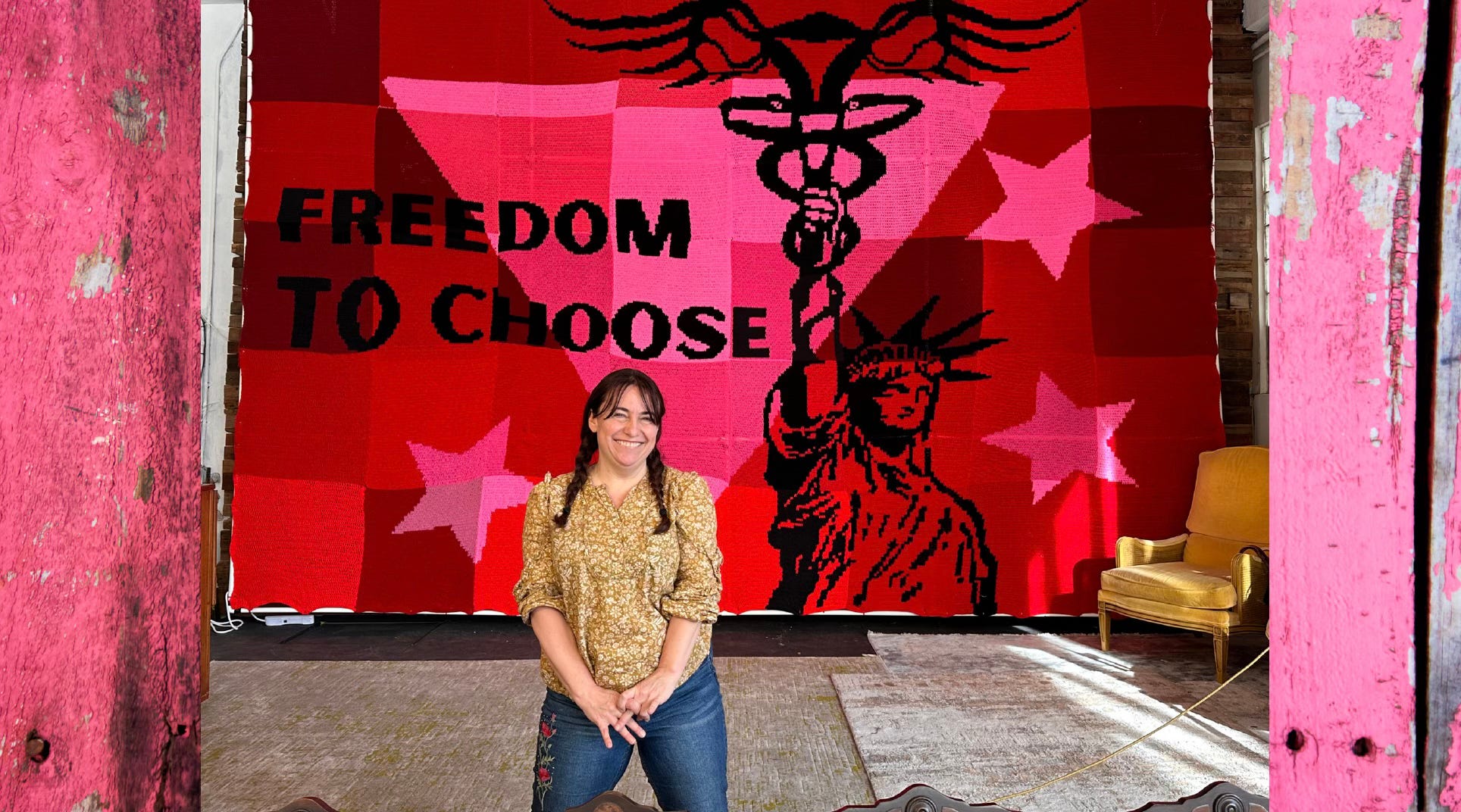
For those of us already working at the intersection of craftivism and fiber arts, much of the history Nehrig traces will feel like familiar territory. And some of it will not.
The Liberty Crochet Mural, the nationwide craftivist project created in response to the overturning of Roe v. Wade, is composed of crocheted panels made by volunteers across the country and joined into a single image of liberty and bodily autonomy. Since 2023 I have been the Northern California steward of the mural, coordinating its display in San Francisco and speaking alongside doctors, nurses, and artists about what it means to bring this particular form to this particular moment.
The lineage Nehrig traces of women using textile to say the things they were not otherwise permitted to say runs through all of that work. I knew the tradition. What the book offers is depth and breadth I hadn’t encountered in one place before: the sampler and the protest banner, the story cloth and the mural, these are the same impulse moving through different hands across different centuries. Nehrig documents it with the rigor of a researcher and the feeling of someone who makes things herself.
She writes that textiles have been a way for women to convey powerful messages of self-expression and political protest. Reading that, I thought about the women who crocheted their squares for the Liberty Mural, many of them at kitchen tables, some of them in the middle of grief or rage, all of them turning that energy into something they could put their hands on and send forward. That is how thread becomes language. That is what Nehrig is mapping.
The stories are powerful:
An eighteenth-century Quaker boarding school used embroidered samplers to teach girls mathematics and geography, encoding education into textile because it was one of the few vehicles women were permitted to use.
The Miao women of southern China, in the absence of a written language, passed their histories down through elaborate story cloths. Their thread did what letters and ink could not.
Quechua weavers are working today to preserve and revive Incan traditions through their practice, reclaiming cultural knowledge that colonial systems tried to erase.
A midcentury British women’s postal art exchange built community among women who would never meet in person, their sewn works traveling across distances to connect them.
Each story expands the frame of what we think textile making is and what it has always been capable of.
The Psychological Dimension
For those of us who make, who have always made, who have sometimes struggled to explain to people who don’t do this why it matters, Nehrig has built an archive of proof. The impulse we feel when we pick up our hooks or our needles or our shuttles, the one that says this is necessary, that it connects us to something larger, that it is not a small or trivial thing, turns out to be one of the most human impulses there is.
What distinguishes this book from other histories of textile work is Nehrig’s clinical lens. She is not just cataloguing stories. She is asking what these practices did and do to the inner life of the people who practice them. If you know me and the way that my work has developed over the years, you know my passion for this lens.
Her framework will be familiar to anyone who has read the research on craft and mental health. But Nehrig does something more than cite studies. She shows the evidence embedded in the historical record itself, in the choices women made about what they made, when, and with whom.
The woman in Nigeria she interviewed who came to textile work after surviving abuse, rebuilding herself through making. The collective workshops where women who had been displaced or outcast learned to weave and sew together, recovering something of their dignity and capability in the process. These are not anecdotes about a “hobby”; they are evidence of a profound human need that textile work has reliably met across cultures and centuries.
I find myself thinking of the women I interviewed for Crochet Saved My Life, and the many women across crafting that I’ve interviewed since, who described their craft in similar terms: as a way back to themselves, a way of processing what could not yet be spoken, a way of staying present when presence felt unbearable. Nehrig is showing us that those women are part of an unbroken line, one that goes back much further than any of us knew.
Nehrig’s central argument is that it is with thread that women wrote. All of those hands, all of those centuries, all of that language made tangible and passed forward.
We, all of us, are still writing.
Others’ Thoughts On This Book
My experience and opinion and reading of this book is just one take among many. And many of those are actually here on Substack. Do peruse these pieces from Laura McLaws Helms, Laila Simon, Lakshmi Sarah, Hailey Brock and Rebecca


and notice this terrific comment from Diane Faye on a piece by Katina, Creative Scientist:

This resonated so deeply. I have a master's in mental health and I crochet, so the intersection of craft and healing is something I think about a lot. The vagus nerve science shows why repetitive hand movements calm our nervous system. Women have known this in their bodies for centuries before science caught up. Thank you for connecting these threads
Thanks for including my comment! I still continue to recommend this book to as many as I can. It’s truly a great piece and raised my awareness and appreciation for the textile work women do with their hands.