
The Meditation You Are Already Doing: Fiber Arts as Spiritual Practice
This is the physiology of what quilters, embroiderers, and weavers have known in their hands for a very long time. The body catches up with the tradition.


You have probably already noticed it. The way a crochet session that begins in a knotted, agitated place tends to end somewhere quieter. The way you can sit down to embroider while a conversation loops in your head and find, forty-five minutes later, that the loop has loosened. The way knitting pulls you somewhere that is difficult to name: present but unhurried, your hands knowing what to do while the rest of you settles.
You may have chalked this up to distraction. To keeping your hands busy. To having something to look at that isn’t a screen.
But it’s possibly deeper than that. What you are doing when you stitch, hook, or quilt with any kind of regularity is a form of meditation. For many makers, across centuries, across cultures, across wildly different relationships to faith and practice, it has always been a form of spiritual practice too.
This piece is for the makers who have sensed this and have lacked the language for it. And for those who have never thought of their crochet or their embroidery in those terms at all, but who are curious.
What Spiritual Practice Means Here
Before going further, let’s sit with the phrase “spiritual practice” because it may carry a lot of weight. For some readers, it calls up formal religious observance. For others, it suggests incense and intention-setting, which may or may not resonate. And for others still, it might feel like language that belongs to someone else’s life.
I want to use it in the broadest possible sense in this discussion today: any practice that connects you to something larger than the immediate demands of your day. Any practice that creates a quality of presence and meaning that ordinary activity rarely offers. Any practice that leaves you feeling more yourself rather than less. This includes religious practice but requires none of it. It includes formal meditation but extends well beyond it.
By this definition, your fiber arts practice may already qualify, and if it does, it probably has for longer than you have been giving it credit for.
What Happens in the Body When You Stitch
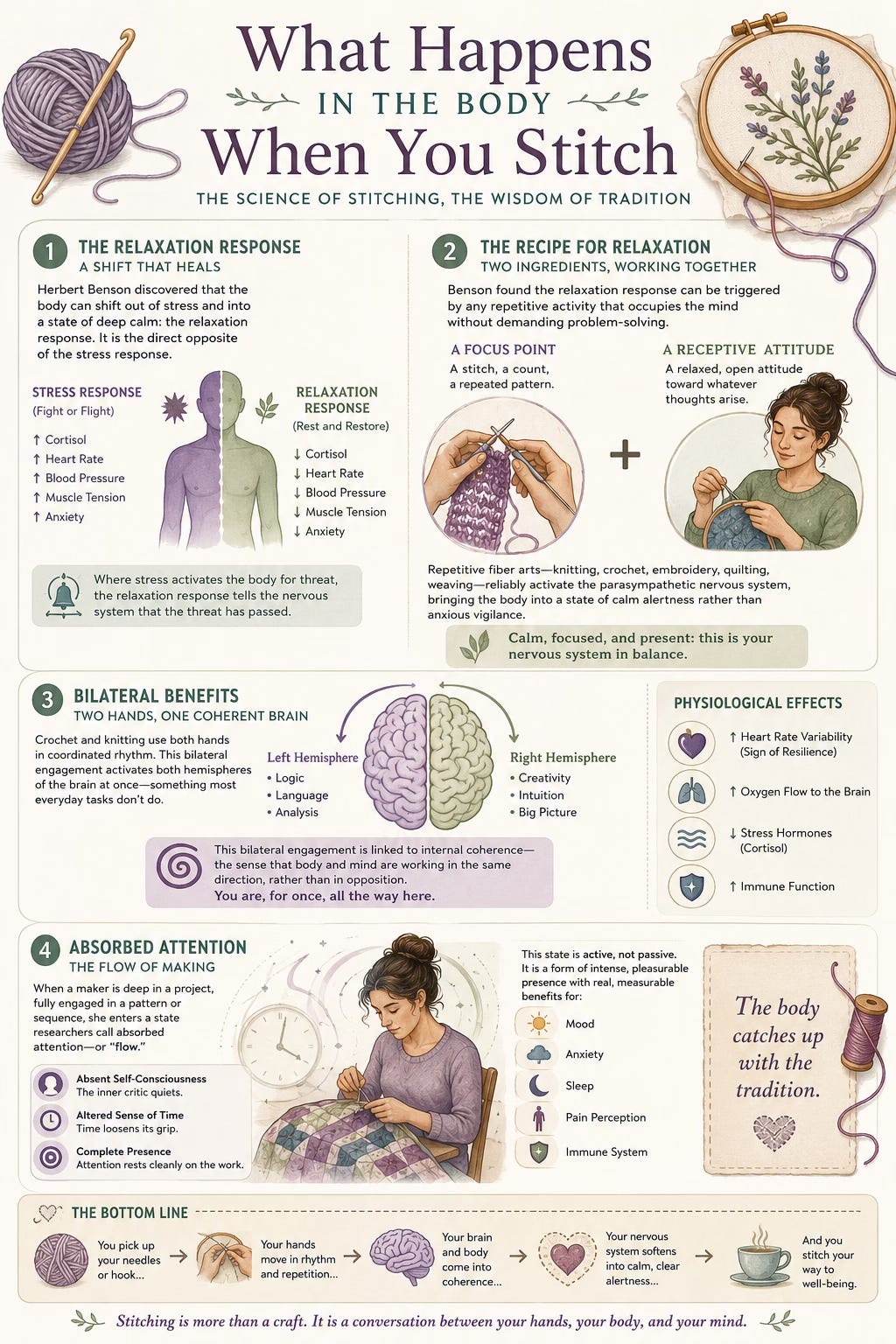
The physiologist Herbert Benson spent decades studying what he called the relaxation response: a measurable shift in the body’s physiology that is the direct opposite of the stress response. Where the stress response raises cortisol, heart rate, and blood pressure, the relaxation response lowers all three. Where stress activates the body for threat, the relaxation response tells the nervous system that the threat has passed.
Benson found that the relaxation response can be triggered by any repetitive activity that occupies the mind without demanding problem-solving. The key is two things working together: a focus point (a stitch, a count, a repeated pattern) and a relaxed, receptive attitude toward whatever thoughts arise. Repetitive activities that meet these conditions, including knitting, crochet, hand embroidery, and quilting, reliably activate the parasympathetic nervous system, bringing the body into a state of calm alertness rather than anxious vigilance.
The bilateral component of many fiber arts adds another layer. Crochet and knitting involve both hands working in coordinated rhythm, which engages both hemispheres of the brain simultaneously in a way that differs from most everyday tasks. This bilateral engagement has been linked to states of internal coherence: the sense that the body and mind are working in the same direction, rather than in opposition. It is a neurological description of something many experienced makers know from the inside: the feeling that you are, for once, all the way here.
Research on absorbed attention in skilled activity adds another dimension. When a maker is deep in a project, a pattern that requires full concentration, a sequence that cannot be set aside, she enters a state that researchers describe as absent self-consciousness. The normal background noise of self-monitoring quiets, the sense of time passing loosens, and the attention rests cleanly on the work. This state is an active one, a form of intense, pleasurable presence that has real effects on mood, anxiety, and the immune system.
This is the physiology of what quilters, embroiderers, and weavers have known in their hands for a very long time. The body catches up with the tradition.
Reciprocity and the Materials
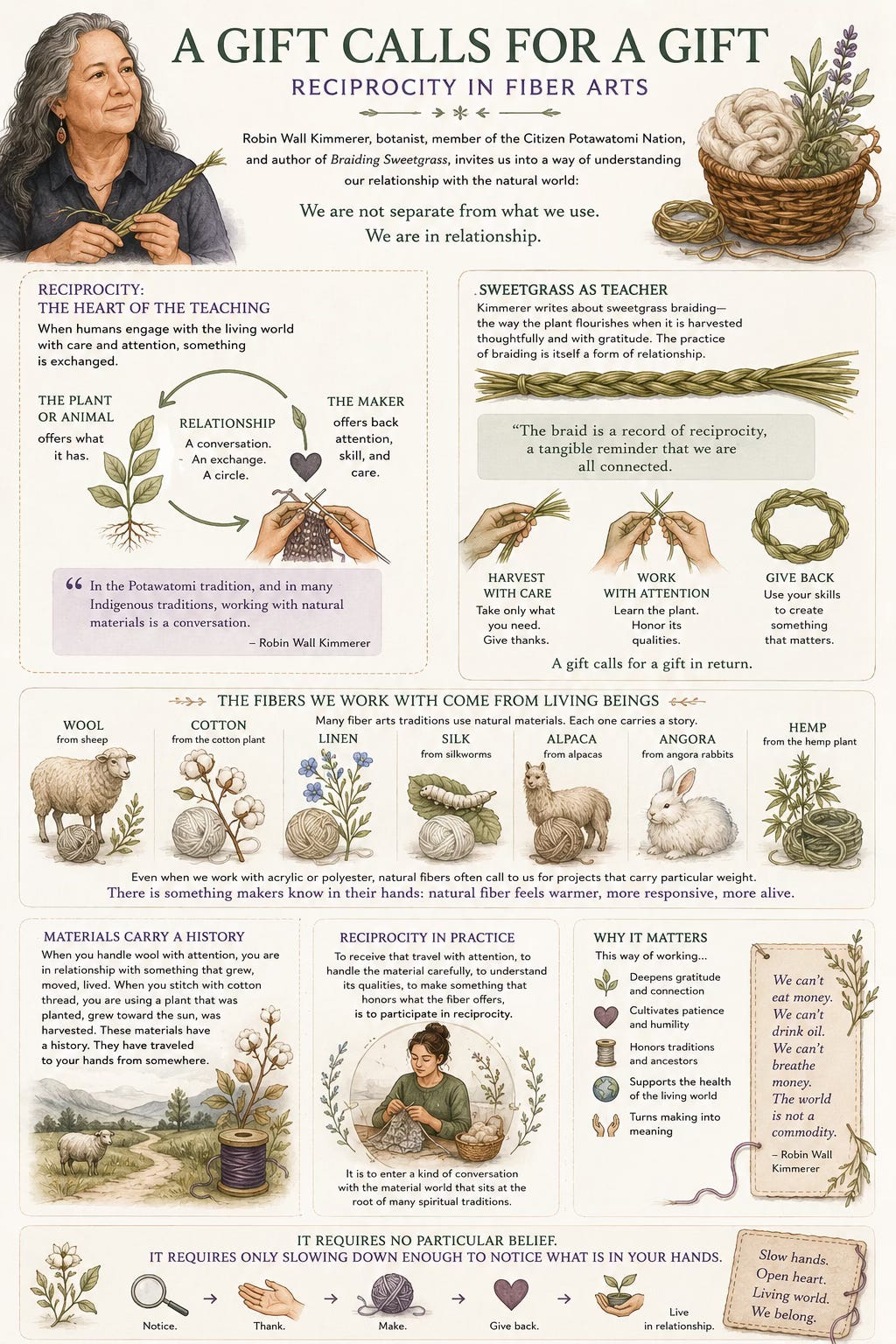
Robin Wall Kimmerer is a botanist, a member of the Citizen Potawatomi Nation, and the author of Braiding Sweetgrass. In that book, she articulates a way of understanding our relationship to natural materials that I have found deeply applicable to fiber arts.
Kimmerer’s central argument is about reciprocity: the idea that when humans engage with the living world with care and attention, something is exchanged. She writes about sweetgrass braiding specifically, the way the plant flourishes when it is harvested thoughtfully and with gratitude, the way the practice of braiding is itself a form of relationship. In the Potawatomi tradition, and in many Indigenous traditions, working with natural materials is a conversation. The plant or fiber offers what it has. The maker offers back attention, skill, and care. A gift calls for a gift in return.
Many fiber arts traditions use natural materials: wool from sheep, cotton from the bolls of the cotton plant, linen from flax, silk from silkworms, alpaca, angora, hemp. Even makers who primarily work with acrylic or polyester often reach for natural fibers for projects that carry particular weight. There is something many makers already know about the feel of natural fiber in the hands: something warmer, more responsive, more alive than synthetic alternatives.
Kimmerer might say this is because the material carries something from the living being it came from. When you handle wool with attention, you are in relationship with something that grew. When you stitch with cotton thread, you are using a plant that was planted, grew toward the sun, was harvested. These materials have a history. They have traveled to your hands from somewhere.
To receive that travel with attention, to handle the material carefully, to understand its qualities, to make something that honors what the fiber offers, is to participate in reciprocity. It is to enter a kind of conversation with the material world that sits at the root of many spiritual traditions.
This requires no particular belief. It requires only slowing down enough to notice what is in your hands.
The Long Tradition: Fiber Arts as Prayer and Practice
Across cultures and across time, fiber arts and handcrafts have been understood as spiritual practice long before anyone called them that.
Tibetan Buddhist monks create elaborate sand mandalas over days or weeks of concentrated effort, then destroy them upon completion: the destruction as essential as the making, an embodiment of impermanence. Prayer beads across Christian, Islamic, Hindu, and Buddhist traditions use the repetition of touch to anchor the mind in devotional practice. Medieval tapestry weavers in European convents understood their work as a form of prayer that simply happened to take textile form. The weaving traditions of many Indigenous cultures are inseparable from ceremony, from the honoring of ancestors, from the maintenance of the relationship between the human world and the natural world.
In African American history specifically, fiber arts have carried this spiritual weight in particularly documented ways. Quilting has functioned as prayer, as memorial, as witness, as the medium through which love and grief and hope were passed from hand to hand and generation to generation. Toni Morrison, in Beloved and throughout her literary projects, honored the way Black women’s domestic creative labor has always been something more than craft. The women in her novels, and in the history she drew on, made things as acts of love, as acts of resistance, as acts of spiritual maintenance. The quilt, the stitching, the textile made in the hours between other work: these were never merely useful. They carried meaning that formal art world categories were never quite wide enough to hold.
Rosie Lee Tompkins made her quilts explicitly as prayers. She sat down to each one with a particular person in mind, with a spiritual intention, stitching Bible verse and found imagery and her own name through pieces of velvet and faux fur collected from Bay Area flea markets. This is exactly the tradition, ancient, wide, and continuing, that your own fiber practice sits within, whether you know it or not.

What Changes When You Treat Your Practice as Spiritual
The research on the relaxation response and absorbed attention describes what happens physiologically during an ordinary fiber arts session. What happens when you bring intention to that session is something additional.
Intention, in this context, requires no complex ritual. It means pausing before you begin. It means taking a moment to name, even silently, what you are bringing to the work. It means making a choice about the quality of attention you want to offer this session, rather than falling into it by accident.
Makers who work with this kind of intention often report that the experience of the session changes, even when the physical activity is identical. The work feels more purposeful. The calm that arrives feels less like a side effect and more like something they have participated in creating. The object that results carries something of the attention that made it.
This is what Kimmerer means by reciprocity. The gift calls for a gift in return. When you arrive at your making with care and presence, the making gives back something proportional to what you brought.
Making for Someone
One dimension of Rosie Lee Tompkins’ practice deserves particular attention because any maker can adopt it. She sat down to quilt for someone. Many of her quilts were made with a particular family member or friend in mind: they can be understood, as one exhibition account puts it, as prayers on their behalf.
This practice of making with a person in mind is one of the oldest in fiber arts traditions. The prayer shawl movement in contemporary churches operates on exactly this principle: a garment made for someone who is grieving, or ill, or facing something hard, with that person in mind throughout the making. The maker’s attention travels with the object.
A formal context is optional. Before you begin, decide who this session is for. It might be someone who needs comfort. It might be someone you are grateful for. It might be someone you have been worried about and cannot reach. The making becomes a form of attention directed outward, a way of caring for someone when other forms of care feel insufficient.
Many makers who try this report that the session feels different from the start. The work matters more immediately. The calm that arrives is accompanied by a sense of connection, of doing something that extends beyond the object.

On Silence
Most contemporary making happens with something playing in the background: a podcast, a show, an audiobook, music. These are fine choices. They make the hours pass pleasantly and often accompany some of the finest work makers produce.
And there is also something distinct about making in silence, or in what Quakers call expectant waiting, and what meditators call open awareness: a receptive, alert quiet that differs from the absence of thought. It is a different relationship to thought.
When you make in silence, the sounds of the work come forward. The soft pull of yarn through your hands. The rhythm of the hook or the needles. The sound of thread being drawn through fabric. These sounds, inaudible over audio, are the sounds of your practice. They are the sounds of the repetition that is doing its quiet neurological work on your nervous system.
Making in silence for a single session, even briefly, gives you a chance to experience the practice on its own terms rather than as a backdrop to something else. Some makers find it uncomfortable at first. Most find that the discomfort passes and what remains is a quality of presence they had not known was available.
Five Things to Try This Month
Take what fits. Leave the rest.
Before beginning your next session, pause for sixty seconds and name, even silently, what you are bringing to the work. This can be as simple as “I want to be present” or as personal as a name.
Give one session this month to silence. Keep it brief if that feels right. Pay attention to what the session feels like without audio.
Begin one project with a person in mind. Choose someone who could use your attention. Let the making carry that person through the session.
After a session, take two minutes to notice what changed. What did the body carry in, and what does it carry out? Over time, the before and after become a record of what the practice is actually doing.
If you work with natural fiber, wool, cotton, linen, silk, take a moment at the start of a session to notice it. Feel its weight. Consider where it came from. This is Kimmerer’s reciprocity in its simplest form: acknowledging that the material has a history, and that you are in relationship with it.
The tradition you are joining is thousands of years old. The practice you already have is enough to begin.


Thank you for sharing my post ❤️ Crochet is a slow craft by nature and it is so wonderful to experience if that natural pace can be honored ✨
This is a beautiful piece, with lots of information. Thank you. For me it makes a difference what kind of project I'm crocheting. If it's something new and/or difficult it can feel really, really frustrating. Not relaxing at all. If it's something familiar or where I don't need to count it's, for me at least, really easy to fall in a flow. Happy crocheting.